


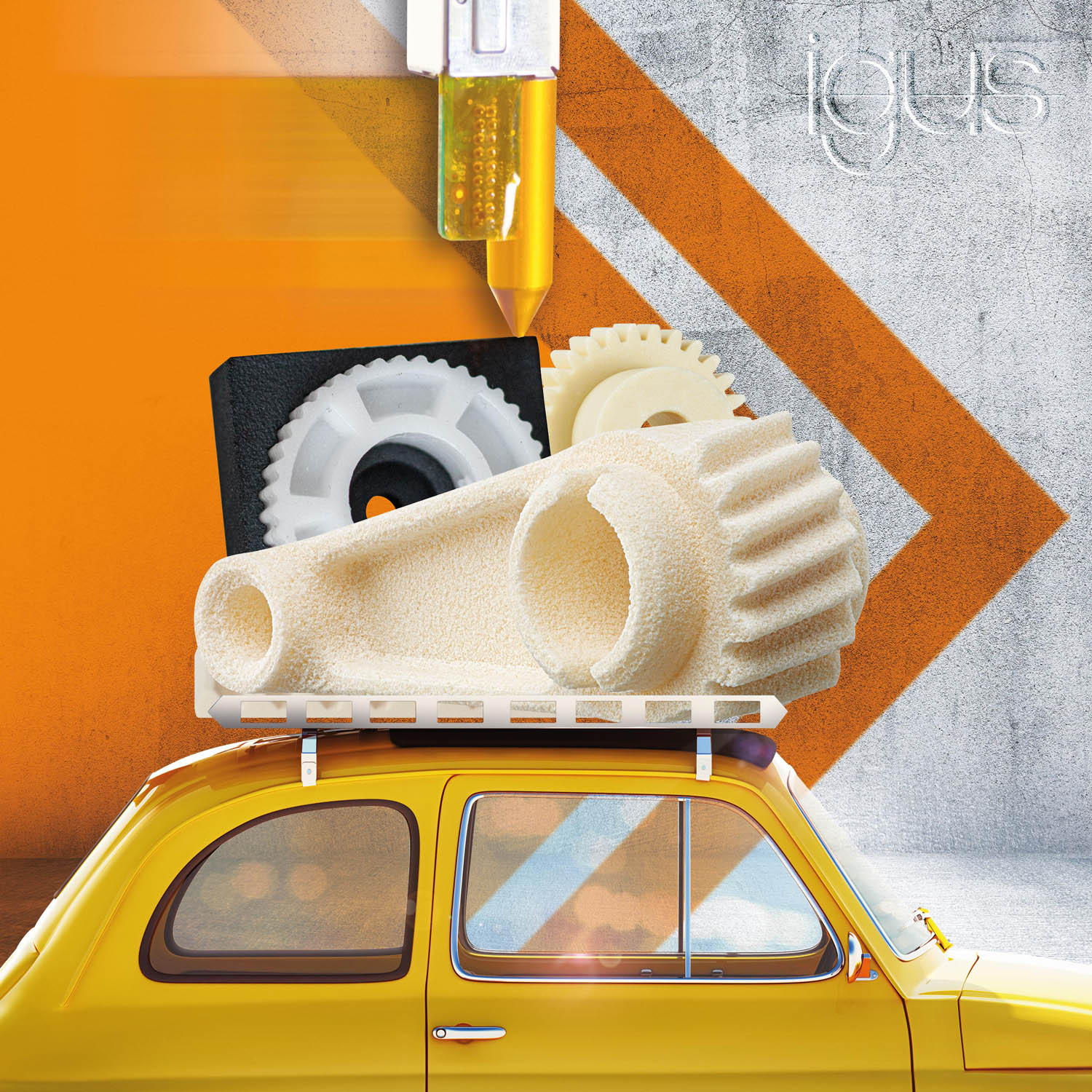
Laboratory tests have been conducted by technical staff at polymer manufacturing company, igus, to compare traditional Polyoxymethylene (POM) plastics performance to 3D printed plastics.
POM has been a standard engineering plastic for wear-resistant and mechanically loaded components for decades. Its strength has become the standard for components like gears, bearings and bushes, as well as other moving components. With new tribological 3D-printing materials from igus engineers wanted to evaluate the new materials that can give them new options particularly for customised or low-volume parts as well as replacement components when required.
The new white paper from igus compared its iglidur 3D-printing materials directly with POM to examine friction, wear and service life in different applications. The results indicate that appropriately selected igus 3D-printed materials can provide a practical alternative to conventionally machined POM in a number of applications. The comparisons were based on grease-free testing which is relevant for applications where additional lubrication was undesirable or impractical.
igus develops its iglidur 3D-printing materials specifically for applications involving friction and wear. The materials incorporate solid lubricants into the polymer allowing components to operate without external lubrication. They are available for several additive manufacturing processes including FDM filament, SLS powder and DLP resin.
The testing considered the properties of the material and its behaviour as a finished component. This is important for tribological applications because friction and wear are influenced by the load, speed, mating surface, component geometry and operating conditions.
According to igus, its 3D-printing materials produced lower wear and more stable friction than POM in the tests conducted. Gear testing produced particularly significant differences with the company reporting more than eight times the service life in VDI 2736 testing and ten times longer service life in Framo Morat gear testing. Pivot testing recorded up to five times less wear than POM.
These results apply to the specific materials, components and test conditions used and should not be interpreted as a universal replacement factor for every POM application. They nevertheless demonstrate the potential of tribological additive manufacturing for functional components. igus testing also indicates that its 3D-printing materials can perform in specialised environments where its service life that was comparable with its injection-moulded applications.
Commenting on the tests igus South Africa managing director, Ian Hewat, says material performance is only part of the argument for additive manufacturing while the other advantage is the manufacturing process itself where 3D printing eliminates the need for conventional tooling and allows components to be produced directly from digital designs. A manufacturer can produce a single component or a small batch from a CAD model and produce another version without creating new tooling.
“The comparison does not mean that POM has become redundant. The material remains a well-established engineering material with predictable characteristics and established conventional manufacturing methods. For high-volume production of identical components, machining, injection moulding or other established processes can remain economically attractive.
“We think the case for 3D printing is strongest where production quantities are relatively small, where geometries are complex or a replacement part is needed quickly and the choice depends on the application rather than simply the material,” says Hewat.