


On average, one in five cars produced globally today features an Advanced Driver Assistance System (ADAS).
If your car can Auto Emergency Brake for you, or predict a Forward Collision, or trigger a Lane Departure Warning when you wander into the next lane, or even read and display traffic signs, you’re a member of the ADAS club.
In addition, ADAS-equipped cars will maintain following distances through Adaptive Cruise Control, or adjust your ‘bright’ light activation through High Beam Assist, keep an eye on forward-facing parking distances through Park Distance Control, or even create modern Augmented Reality Heads-Up Displays in more-expensive derivatives of modern vehicle ranges.
But here’s what most owners don’t realise, replace a windscreen and your ADAS camera needs to be recalibrated to function effectively. Think of it as dropping your favorite set of bifocals and a lens shifting due to the impact, it alters what and how you see. ADAS is no different.
ADAS technology uses a sensor or groups of sensors to detect and analyse the driving environment around a vehicle. These can include ultrasonic, LiDAR (light detection and ranging) and RADAR as well as Mono, Stereo and Trifocal cameras. And many of these cameras are located at the upper, inner surface of the windscreen.
Manufacturer guidelines for ADAS-equipped vehicles mandate recalibration after any glass replacement or camera removal, to teach the vehicle safety system software the new camera position after it has been re-attached to the glass. Due to normal manufacturing tolerances of the windscreen and the camera bracket, the camera will be pointing in a different direction following the installation of a new windscreen.
Skipping recalibration can lead to:
- Incorrect functionality, loss, or reduced accuracy of ADAS functions
- False alarms or no alerts at all, creating unpredictable ADAS behaviour
- Increased accident risk because systems may fail to engage or activate incorrectly
- Legal and insurance implications, as many insurers require proof of recalibration after windshield replacement
- A one-degree misalignment can cause an error of approximately 2.4 metres over a distance of 30 metres, which is critical at highway speeds
More concerning is that, according to PG Glass locally, manufacturer workshop diagnostic scans do not show a fault code for a missing, or non-accurate recalibration. A workshop diagnostic scan may highlight existing vehicle diagnostic codes, but it will not indicate that recalibration is required or has been completed. This creates confusion because the car may appear “fault-free” even though ADAS is compromised. Only recalibration ensures correct functionality of the cameras supporting ADAS features, making this a safety-critical blind spot for local modern-car owners.
In essence, ADAS relies on precise camera alignment. If the camera is not recalibrated after a windscreen replacement, the system may continue using its original reference point, which is now incorrect as the camera position or orientation has changed. This can cause critical safety features like Lane Keep Assist (LKA) and Autonomous Emergency Braking (AEB) to malfunction. In tests, mis-calibrated cameras led to vehicles failing to stop in time during AEB activation, resulting in collisions, or deviating from the lane in the case of a malfunctioning LKA system.
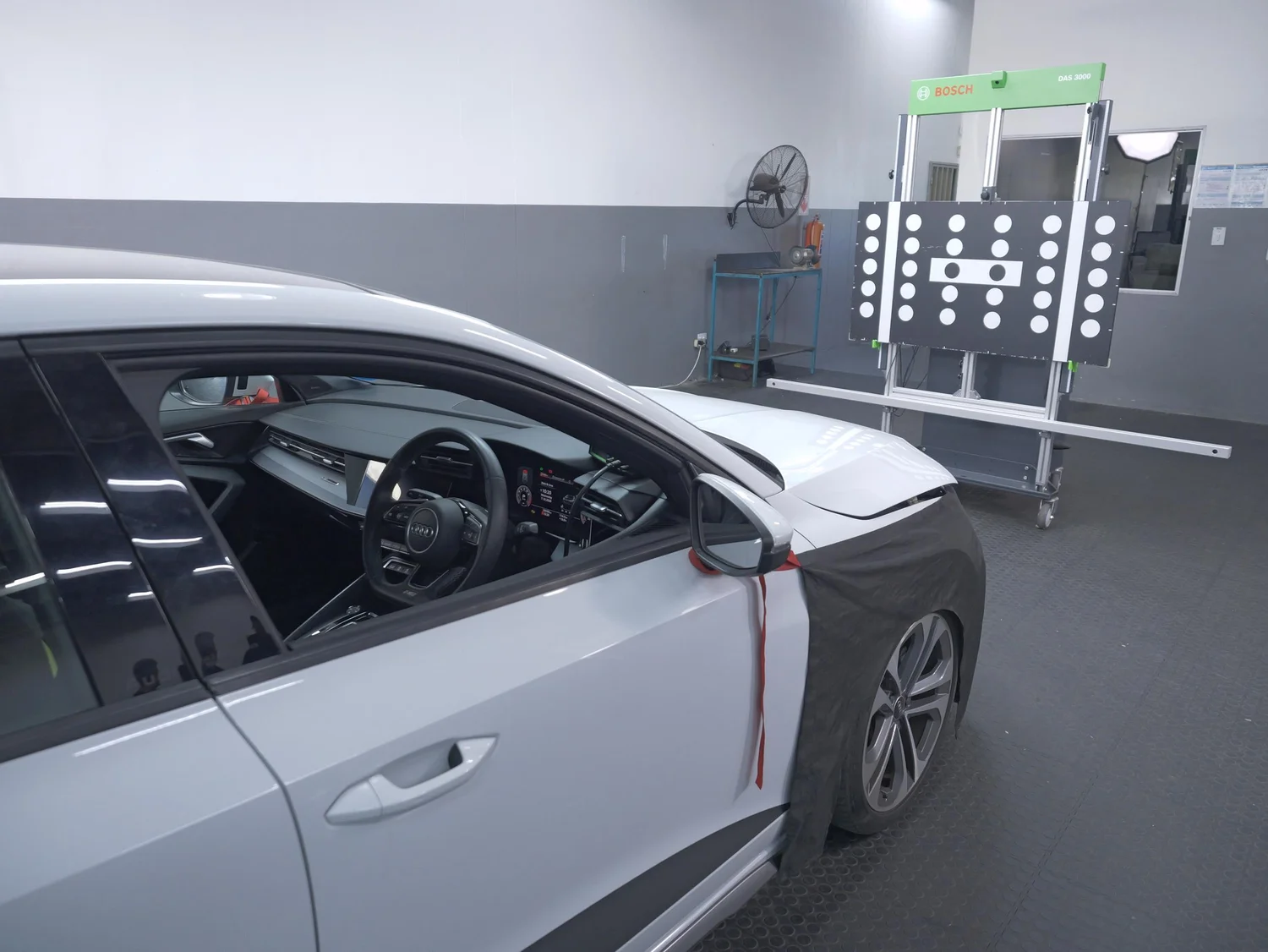
Recalibration at a glass fitment centre takes the form of two activations, one Static and one Dynamic, post windscreen installation, with the AA guided firsthand through the process and its merits. The first activation, Static, is reminiscent of wheel alignment, using various manufacturer-approved vehicle calibration ‘target’ boards.
Technicians position these target boards in front of the vehicle, based on manufacturer approved static recalibration repair methods. These define the way in which a fixed physical target board is to be positioned accurately in front of the vehicle, at a defined distance and height and aligned to the vehicle centre (or thrust) line. This can only be done in a controlled environment where the floor is level and adequate lighting is present.
Once initiated, the Static digital recalibration process uses diagnostic tools plugged into the vehicle’s on-board diagnostic port. Once paired, the equipment dials into a remote diagnostic expert who accesses the manufacturers diagnostic software and remotely activates the calibration. As an Over The Air (OTA) practice it is quick with minimal physical installation required.
Dynamic recalibration, done live on the open road, teaches the ADAS software the ‘new’ camera position or orientation while the vehicle is driven, using real-world road markings and environmental cues. A diagnostics tool is again needed to initiate the recalibration. Once completed, your vehicle will have a permanent record of recalibration alongside a recalibration certificate, which your insurance company may call for based on the windscreen (or a future accident) claim.
“The very first ADAS recalibration took place globally in 2014. Over five million vehicles were recalibrated globally, post a windscreen replacement, in 2025 alone. ADAS systems in cars in South Africa are growing significantly, with forward-facing cameras in the local car parc growing from around 2% in 2020 to 17% at the end of 2024. We need local motorists to understand the safety and importance of ADAS recalibration,” says Eddie Irving, Head of New Markets at Belron, the parent company to PG Glass in South Africa. “PG Glass has established itself as a leader in Advanced Driver Assistance Systems recalibration services in South Africa through a significant investment in industry-leading calibration technology, technician training, and operational capability.”
“As an organisation committed to vehicle safety in South Africa, the AA has been quoting the benefits of ADAS through NCAP and #SaferCarsForAfrica safety ratings for many years now. Recalibration of ADAS becomes the equivalent of a vehicle recall, it is mandatory for the ongoing effective safety parameters of the modern vehicle. Like with a safety recall, it is a cost-free solution that can save many lives. The AA encourages owners to insist on certified recalibration as mandatory with every windscreen replacement undertaken,” says Bobby Ramagwede, CEO of the Automobile Association.
“Ensuring your ADAS system is working at peak performance is a no-brainer, especially when you factor in that a Dutch insurance body study involving one million cars between 2019 and 2021 showed up to 50% less accidents in vehicles with functional Front Collision Warning systems. Functioning ADAS means protected driver, protected passengers and protected road users, including cyclists and pedestrians,” concludes Ramagwede.