


With nearly 1.8 million public charging points built worldwide in 2025, the global total now nears 7 million, but the pace of infrastructure rollout varies dramatically from country to country.
To provide a clearer picture of the charging power available to EV drivers, the team at TradingPlatforms analysed data from the International Energy Agency's Global EV Outlook 2026, including figures for the number of electric vehicles (BEV and PHEV), as well as the number of public charging stations rated slow, fast, and ultra-fast across 46 countries. The full datasheet is available on Google Drive via this link.
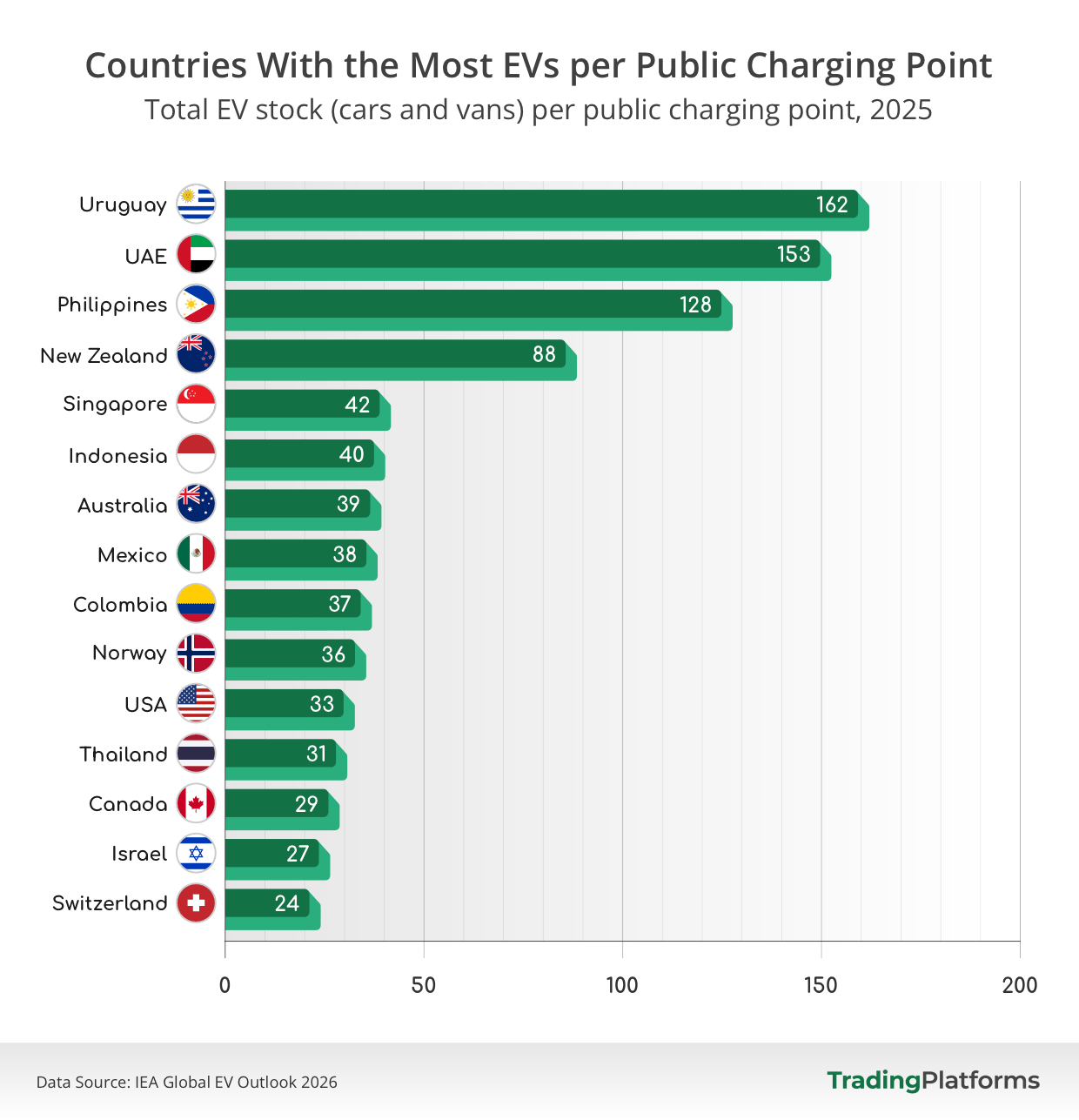
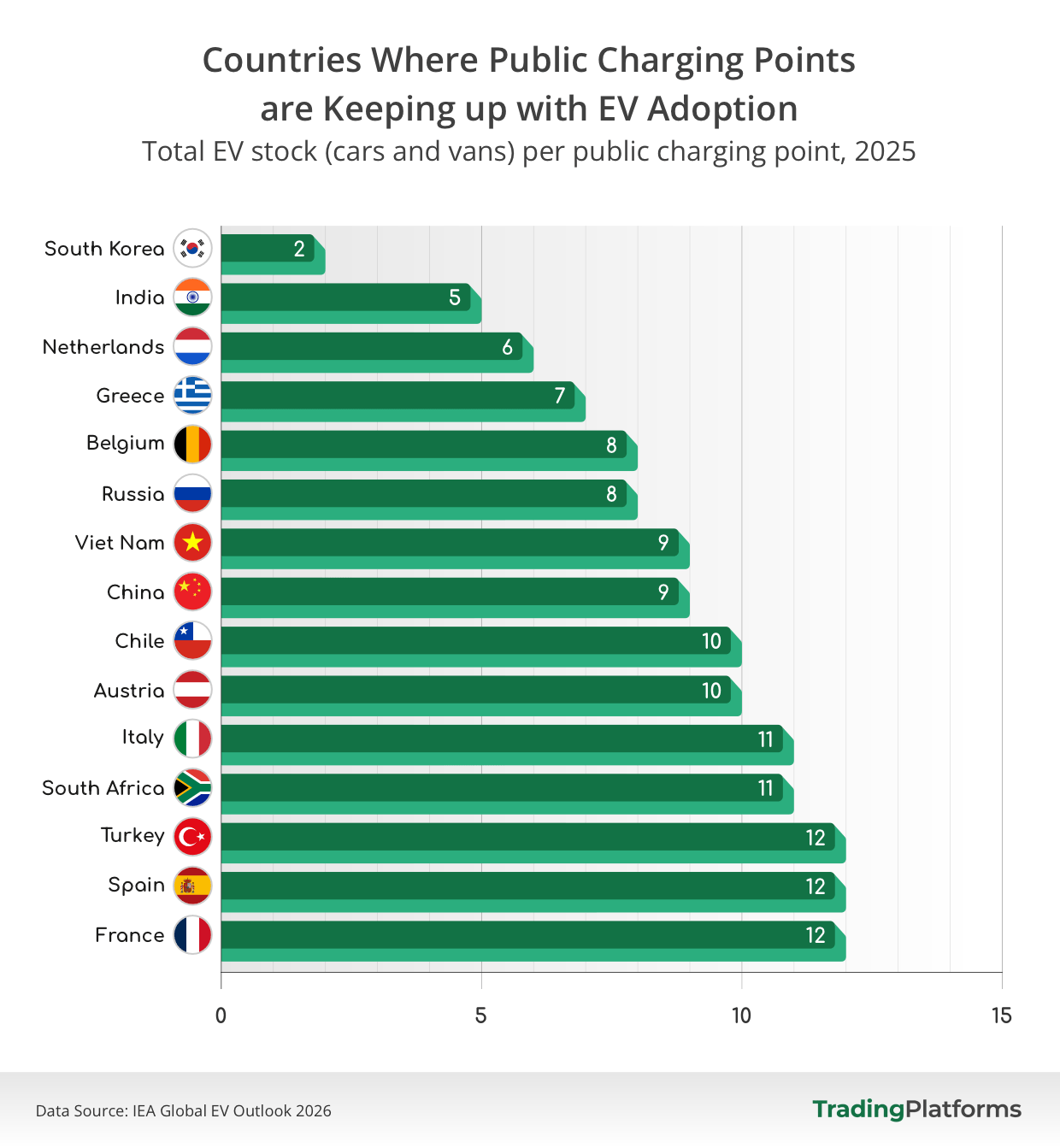
Data shows that Uruguay is the country with the highest ratio of electric vehicles to public charging points, with 162 EVs for every public charger. The South American country is followed by the United Arab Emirates with 153 EVs per charger and the Philippines with 128. At the other end of the ranking, South Korea has the lowest ratio, with just 2 EVs per public charging point, despite its EV fleet reaching nearly one million vehicles in 2025.
These are the countries with the most EVs per public charging station:
(Total BEV + PHEV EV stock vs. total public charging points, 2025)
- Uruguay - 25,900 EVs and 160 public charging points (162 EVs per charger)
- United Arab Emirates - 213,700 EVs and 1,400 public charging points (153 EVs per charger)
- Philippines - 35,035 EVs and 274 public charging points (128 EVs per charger)
- New Zealand - 129,992 EVs and 1,470 public charging points (88 EVs per charger)
- Singapore - 51,000 EVs and 1,223 public charging points (42 EVs per charger)
- Indonesia - 185,800 EVs and 4,620 public charging points (40 EVs per charger)
- Australia - 434,000 EVs and 11,100 public charging points (39 EVs per charger)
- Mexico 158,000 EVs and 4,120 public charging points (38 EVs per charger)
- Colombia - 49,000 EVs and 1,330 public charging points (37 EVs per charger)
- Norway - 1,109,000 EVs and 31,200 public charging points (36 EVs per charger)
These are the countries with the fewest EVs per public charging station:
(Total BEV + PHEV EV stock vs. total public charging points, 2025)
- Korea - 994,000 EVs and 491,160 public charging points (2 EVs per charger)
- India - 433,000 EVs and 88,000 public charging points (5 EVs per charger)
- Netherlands - 1,253,900 EVs and 207,300 public charging points (6 EVs per charger)
- Greece - 59,000 EVs and 8,640 public charging points (7 EVs per charger)
- Belgium - 781,730 EVs and 95,200 public charging points (8 EVs per charger)
- Russia - 84,020 EVs and 9,899 public charging points (8 EVs per charger)
- Viet Nam - 280,240 EVs and 32,000 public charging points (9 EVs per charger)
- China - 44,380,000 EVs and 4,680,000 public charging points (9 EVs per charger)
- Chile - 20,000 EVs and 2,090 public charging points (10 EVs per charger)
- Austria - 355,000 EVs and 35,900 public charging points (10 EVs per charger)
Key highlights from the report:
- Uruguay has the highest number of EVs per public charging point, with its electric vehicle fleet more than doubling from 11,250 in 2024 to 25,900 in 2025. However, the number of public charging points increased from just 140 to 160 over the same period. This means that as of the end of 2025, there were 162 electric vehicles for every charging station in the country.
- Asia and the Middle East are seeing rapid growth in EV adoption, but charging infrastructure is not keeping pace uniformly. The United Arab Emirates has the highest EV-to-charger ratio in the region, with 153 EVs for every public charging point, followed by the Philippines with 128. The Philippines is a particularly stark example: its EV fleet jumped from just 4,830 in 2024 to 35,035 in 2025, while the number of public charging points remained virtually unchanged at 274 for the whole country. As a result, the number of EVs per public charger increased more than sevenfold in just one year. The rapid rise in adoption is consistent with a wider surge across Southeast Asia, where electric-car sales more than doubled in 2025, supported by measures such as tax and import-duty incentives.
- Other Asian countries are also seeing EV adoption outpace the expansion of public charging infrastructure. Singapore has 42 EVs per public charging point, while Indonesia has 40, despite Indonesia deploying more than 4,500 public chargers through its state-owned power utility. Thailand is also under growing pressure, with 31 EVs per public charger in 2025. The country added roughly 800 public chargers over the span of a year but EV uptake grew even faster, with electric-car sales rising by 70% in 2025 to around 140,000.
- Mexico has the highest EV-to-charger ratio in North America, with 38 EVs per public charging point, compared with 33 in the US and 29 in Canada. Mexico's EV fleet more than doubled from 67,000 in 2024 to 158,000 in 2025, while its public charging network grew by just 25%, from 3,300 to 4,120 points. The US had 7.8 million EVs and 240,000 public charging points, while Canada had 1.1 million EVs and 38,100 points. However, the relatively high ratios in the US and Canada are mostly offset by widespread home-charging, meaning that many EV owners do not depend on public charging as much as in many other countries around the world.
- Norway and Switzerland are the only European countries among the top 15 by EVs per public charging point. Norway has 36 EVs for every public charging point, while Switzerland has 24. Norway's EV fleet reached 1.1 million vehicles in 2025, compared with 31,200 public charging points, while Switzerland had 416,680 EVs and 17,200 public charging points.
- At the other end of the ranking, South Korea has the fewest EVs per public charging point, with just 2 EVs per charger, followed by India with 5 and the Netherlands with 6. South Korea had 491,160 public charging points serving around 994,000 EVs in 2025, while India had 88,000 points for 433,000 EVs. The Netherlands also has one of Europe's largest public charging networks, with 207,300 points serving 1.25 million EVs. These markets have built charging infrastructure at a much faster rate relative to their EV fleets than countries at the other end of the ranking.
‘Countries fall behind on EV charging when adoption moves faster than infrastructure investment. Building chargers ahead of demand requires governments and operators to take on significant upfront costs, but markets such as the Philippines and Uruguay show how quickly a charging gap can emerge when EV uptake surges. By contrast, countries such as South Korea, India, and the Netherlands have invested heavily enough to ensure charging infrastructure is growing ahead of demand.
However, the number of chargers alone doesn’t tell the whole story. Home-charging availability, population density, geography, and charger speed all shape how much pressure is placed on public infrastructure. Ultimately, the countries best positioned for continued EV growth will be those that expand charging capacity in line with, or ahead of, the growth of their EV fleets.’
- comments Martin Tunchev, analyst at TradingPlatforms