


With global EV sales rising for a sixth consecutive month, electric vehicle adoption continues to accelerate across major and emerging markets alike.
As more drivers switch to EVs, the ability of charging infrastructure to keep pace is becoming an increasingly important part of the transition. In light of this, I am writing to share our new report ranking the countries where public charging infrastructure is keeping pace with EV adoption, and where it is falling behind.
To provide a clearer picture of the charging power available to EV drivers, the team at TradingPlatforms analysed data from the International Energy Agency's Global EV Outlook 2026, including figures for the number of electric vehicles (BEV and PHEV), as well as the number of public charging stations rated slow, fast, and ultra-fast across 46 countries. The full datasheet is available on Google Drive via this link.
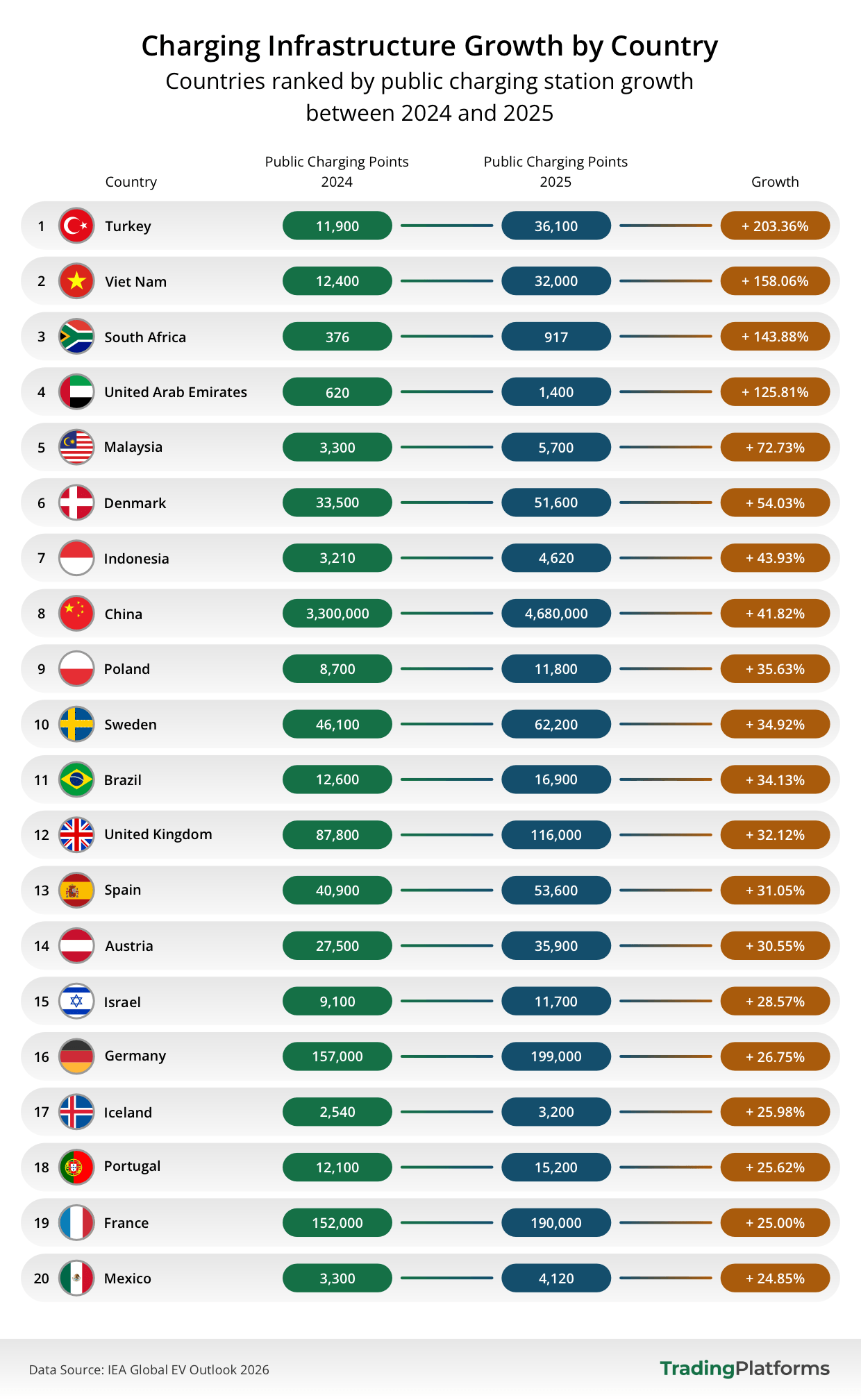
Data shows that Turkey recorded the largest increase in EV charging infrastructure last year, adding 24,200 public charging points and growing its network by an astonishing 203.36%. It is followed by Vietnam, where the number of public charging points increased by 158.06% to 32,000, and South Africa, where the network nearly tripled from 376 chargers in 2024 to 917 in 2025, representing 143.88% growth.
Key highlights from the report:
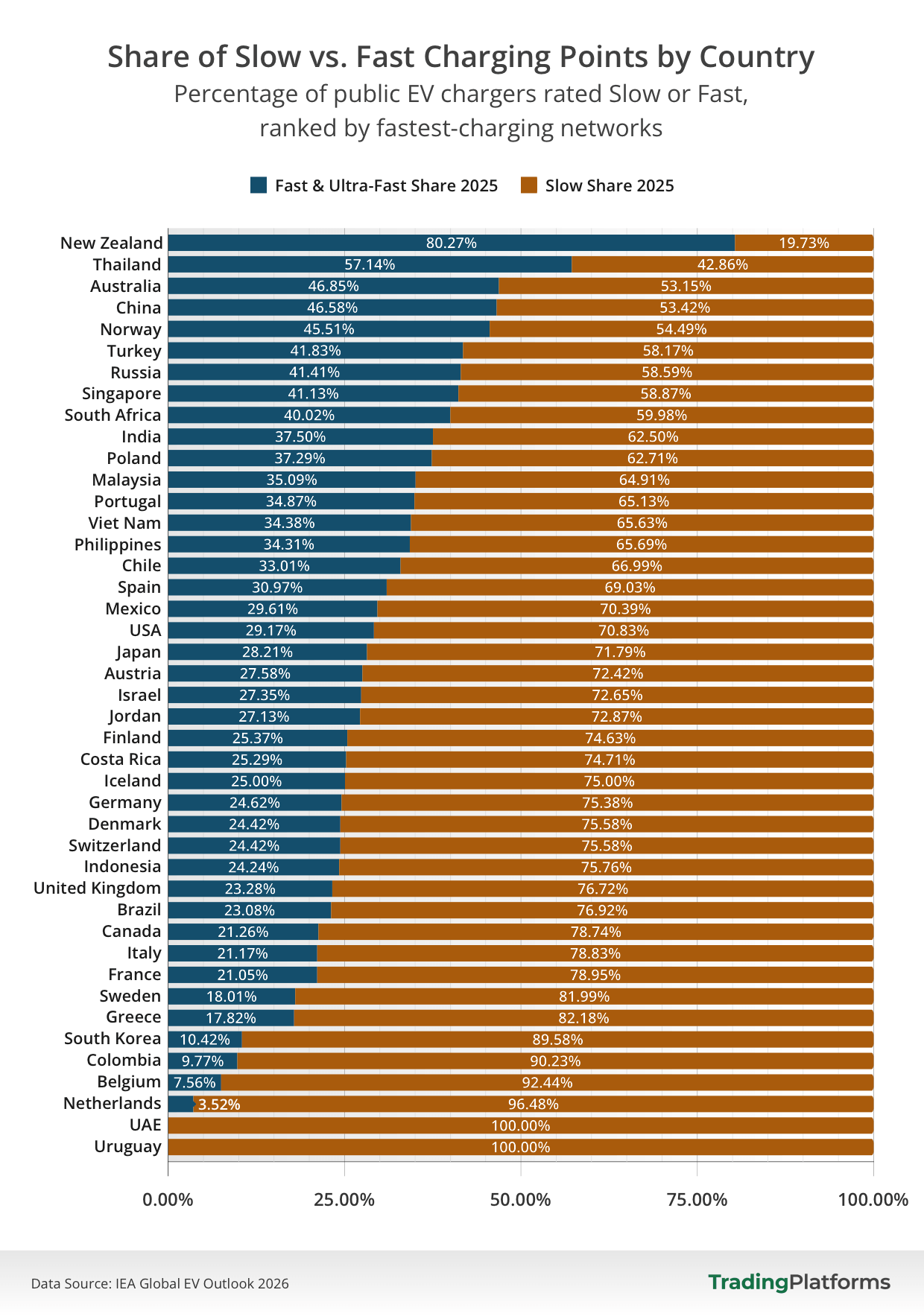
- Turkey recorded the fastest growth in public charging infrastructure, with charging points more than tripling from 11,900 in 2024 to 36,100 in 2025 (+203.4%). The country added 15,000 slow chargers, 5,700 fast chargers, and 3,500 ultra-fast chargers, taking its total network to more than three times its previous size. However, slow chargers accounted for the majority of the expansion, rising from 6,000 to 21,000 and increasing their share of the network from 50.4% to 58.2%.
- Vietnam places second in the ranking, with its public charging network growing 158.1% in a single year, from 12,400 to 32,000 points. The country added 12,500 slow chargers and 7,100 fast chargers, while its share of fast and ultra-fast infrastructure increased from 31.5% to 34.4%. The country added more than 19,000 public charging points in one year, despite starting with a network less than one-tenth the size of China's.
- China added more public charging points than every other country combined, expanding its network by 1.38 million charging stations from 3.3 million in 2024 to 4.68 million in 2025. This included 700,000 new slow chargers, 300,000 fast chargers, and 380,000 ultra-fast chargers, with the number of ultra-fast points almost doubling in a single year.
- New Zealand has by far the highest share of fast and ultra-fast public chargers, with these accounting for 80.3% of its network in 2025, compared with 75.9% in 2024. The country had 910 fast and 270 ultra-fast chargers, compared with just 290 slow chargers, making it the only market in the dataset where slow chargers represent less than one-fifth of the total network. By contrast, slow chargers make up more than 90% of the networks in Belgium and the Netherlands.
- Europe saw several countries significantly expand their public charging networks in 2025, including Denmark (+54.0%), Poland (+35.6%), Sweden (+34.9%), Spain (+31.1%) and Austria (+30.5%). But the fastest-growing networks were not all built in the same way: Poland had the highest share of faster chargers among these leaders, with 23.7% of its network classified as fast and 13.6% as ultra-fast, while Sweden had the largest ultra-fast share at 16.1%. Denmark's network remained more heavily weighted towards slow charging, at 75.6%, although fast and ultra-fast points together already accounted for nearly a quarter of its chargers. Spain and Austria were similarly dominated by slow chargers, which made up 69.0% and 72.4% of their respective networks.
- In North America, the US added 47,000 public charging points, taking its network to 240,000, with ultra-fast chargers increasing from 40,000 to 51,000. Canada grew from 32,100 to 38,100 points, adding 2,700 ultra-fast chargers and taking faster chargers to 21.3% of its network. Mexico recorded the fastest growth in the region, expanding its network by 24.9%, from 3,300 to 4,120 points, while fast chargers more than doubled from 490 to 1,100.
‘Charging your electric vehicle at a public charging point has become less of a hassle and more of a normal part of the transport system. Five years ago, people were still worrying about whether they would be able to reach a charging station before their battery ran out. Today, that is increasingly becoming a thing of the past, with charging points far more widely available and an increasing share able to deliver enough power for a useful top-up in minutes rather than hours.
While access to charging stations remains uneven between countries, cities and households, the world has undoubtedly moved towards building an infrastructure network capable of supporting the global transition from petrol and diesel cars to electric vehicles.’ - - comments Diliana Hristova, analyst at TradingPlatforms.
More information on the number of electric vehicles and charging stations around the world, as well as the complete methodology behind our findings, can be found in the full report.